
AI Trust Starts With the Data It Consumes
Exploring content integrity and data provenance across MCP, RAG, and agentic AI systems.
Much of the conversation around AI trust focuses on the information AI generates. Is it accurate? Can we verify its origin? Has it been manipulated? Who is accountable for it?
These are all important questions, but perhaps we're overlooking an equally important one:
Can we trust the information we're asking AI to trust?
As AI systems become more autonomous, interconnected, and capable of making consequential decisions, establishing trust in the information they consume becomes increasingly important. Even a properly functioning AI system can produce undesirable outcomes when operating on inaccurate, manipulated, outdated, or unauthorized information.
Not every AI trust problem is a model problem. Sometimes, it's a data problem.
The expanding information supply chain
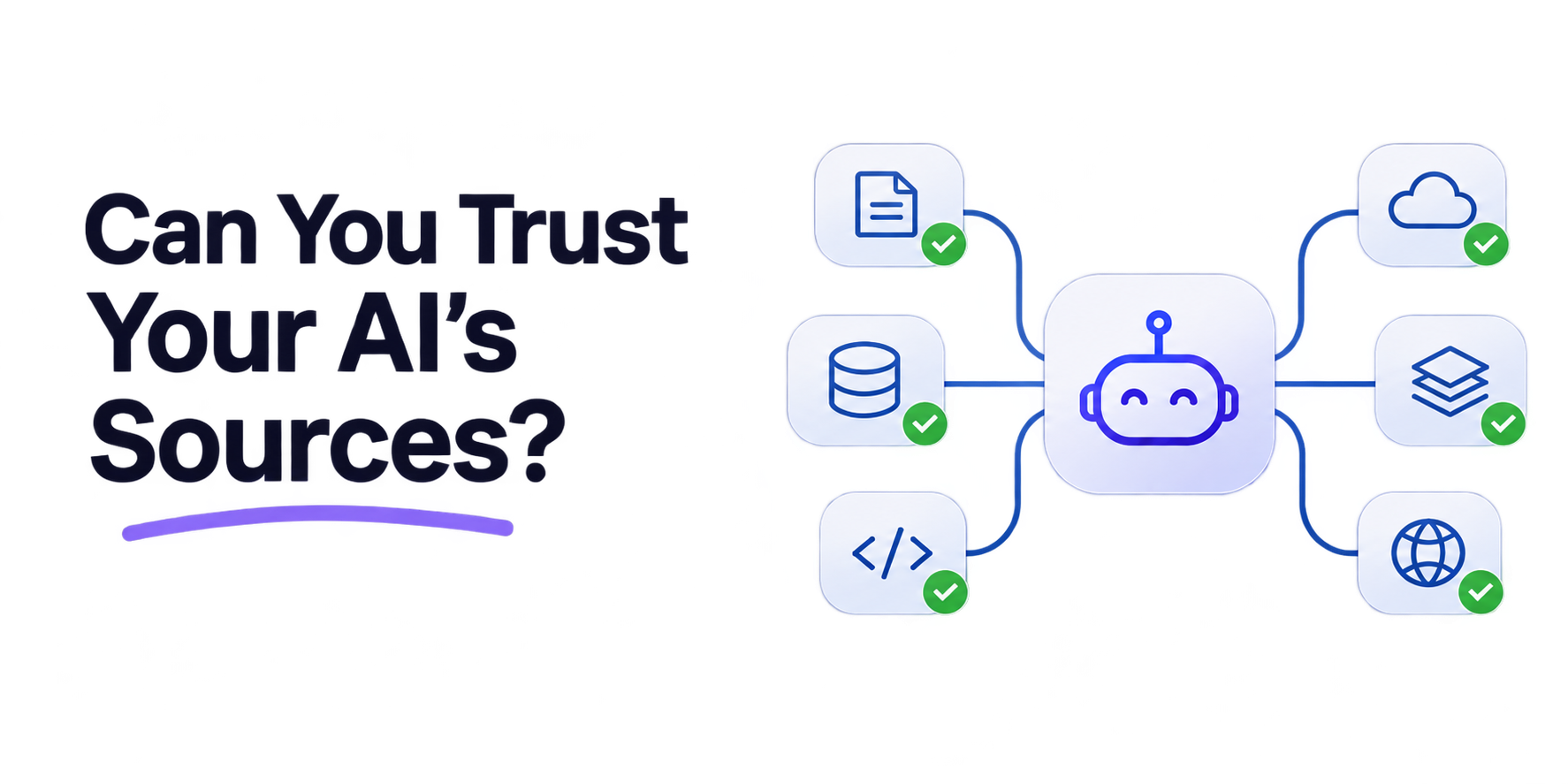
Modern AI systems rarely operate in isolation. They retrieve information, interact with external services, communicate with other agents, and incorporate data from a growing number of sources.
These may include:
- Model Context Protocol (MCP) servers
- Retrieval-augmented generation (RAG) pipelines
- Internal knowledge bases and documents
- Third-party APIs and data providers
- Other AI agents and automated systems
Each of these interactions introduces another point at which information enters the system and potentially influences its behavior.
A recent VentureBeat article explores how a compromised MCP server can influence an AI agent's interactions with other, otherwise trusted tools. Similarly, NIST's research on adversarial machine learning and OWASP's guidance on AI agent and MCP security highlight the security risks associated with externally supplied information.
While authentication, authorization, and access controls are essential to addressing these risks, we believe content integrity and data provenance deserve more attention in the conversation.
Trusting the source versus trusting the content
Authenticating a service and verifying the content it provides are two different things.
Knowing the identity of a data provider, MCP server, or AI agent is important. But as information moves between systems, applications, and workflows, additional questions emerge:
- Can we independently verify where the information originated?
- Has it been modified since it was produced?
- Was it signed by an authorized source?
- Is that source's signing authority still valid?
- Can we establish what information an AI system actually used when making a decision?
Traditional authentication and transport security mechanisms serve important purposes, but they do not necessarily provide persistent, independently verifiable evidence of content origin and integrity throughout its lifecycle.
Of course, verifying the integrity of information does not guarantee its accuracy. A trusted source can still provide incorrect information, and a compromised system may still produce validly signed malicious content.
However, verifiable provenance gives organizations an additional signal on which to base security, governance, and operational decisions.
Establishing trust before inference
Imagine an AI agent capable of accessing information from dozens of sources, but only permitted to make consequential decisions using verified content from approved providers.
Or a RAG pipeline that verifies the integrity of retrieved documents before incorporating them into an LLM's context.
Or an automated decision-making system that preserves verifiable evidence of the information it received and relied upon.
In each scenario, content verification could serve as an additional layer of control, helping organizations establish trust boundaries around the information their AI systems consume.
Rather than relying exclusively on retrospective logging and investigation, verification could become part of the operational workflow itself.
This could be particularly valuable in regulated industries, financial services, healthcare, enterprise automation, and other environments where the origin and integrity of information can have significant downstream implications.
Where BlkSeal fits
At lyfe.ninja, much of our work with BlkSeal has focused on simplifying content signing and verification, particularly for AI-generated and application-generated content.
However, the same capabilities can potentially be applied to the information entering these systems.
BlkSeal is designed to make content integrity practical across a variety of applications through:
- Lightweight, API-driven content signing and verification.
- Support for structured and unstructured digital content.
- Native expiration and revocation of signing authority.
- Integration without the need to manage traditional per-producer public/private key pairs or certificate infrastructure.
These capabilities could support content verification at various points throughout an AI workflow, from data ingestion and retrieval to MCP exchanges, inter-agent communication, and ultimately the content an AI system produces.
The goal is not to replace existing security mechanisms, but to complement them with an accessible layer of verifiable content integrity.
Trust throughout the AI information lifecycle
We see an opportunity to approach AI trust across three complementary stages:
Input verification: Establishing the origin and integrity of the information an AI system consumes.
Output verification: Establishing the origin and integrity of the content an AI system ultimately produces.
Claim grounding: Evaluating whether the claims an AI system generates are supported by its source information.
No single technology can solve all three problems, and none independently guarantees that an AI system is safe, accurate, or trustworthy. Together, however, they represent an opportunity to establish stronger accountability throughout the AI information lifecycle.
As AI systems continue to gain autonomy, we believe organizations should be asking more than whether they can trust the content AI produces.
They should also be asking whether they can trust the information it was given in the first place.
References:
- [1] VentureBeat, “MCP has tightened its authentication rules four times. Older servers may not have kept up.”, November 15, 2026.
- [2] National Institute of Standards and Technology (NIST), “Adversarial Machine Learning: A Taxonomy and Terminology of Attacks and Mitigations”, March 2025.
- [3] Open Worldwide Application Security Project (OWASP), “AI Agent and MCP Security”, OWASP DevSecOps Guideline, accessed November 24, 2026.