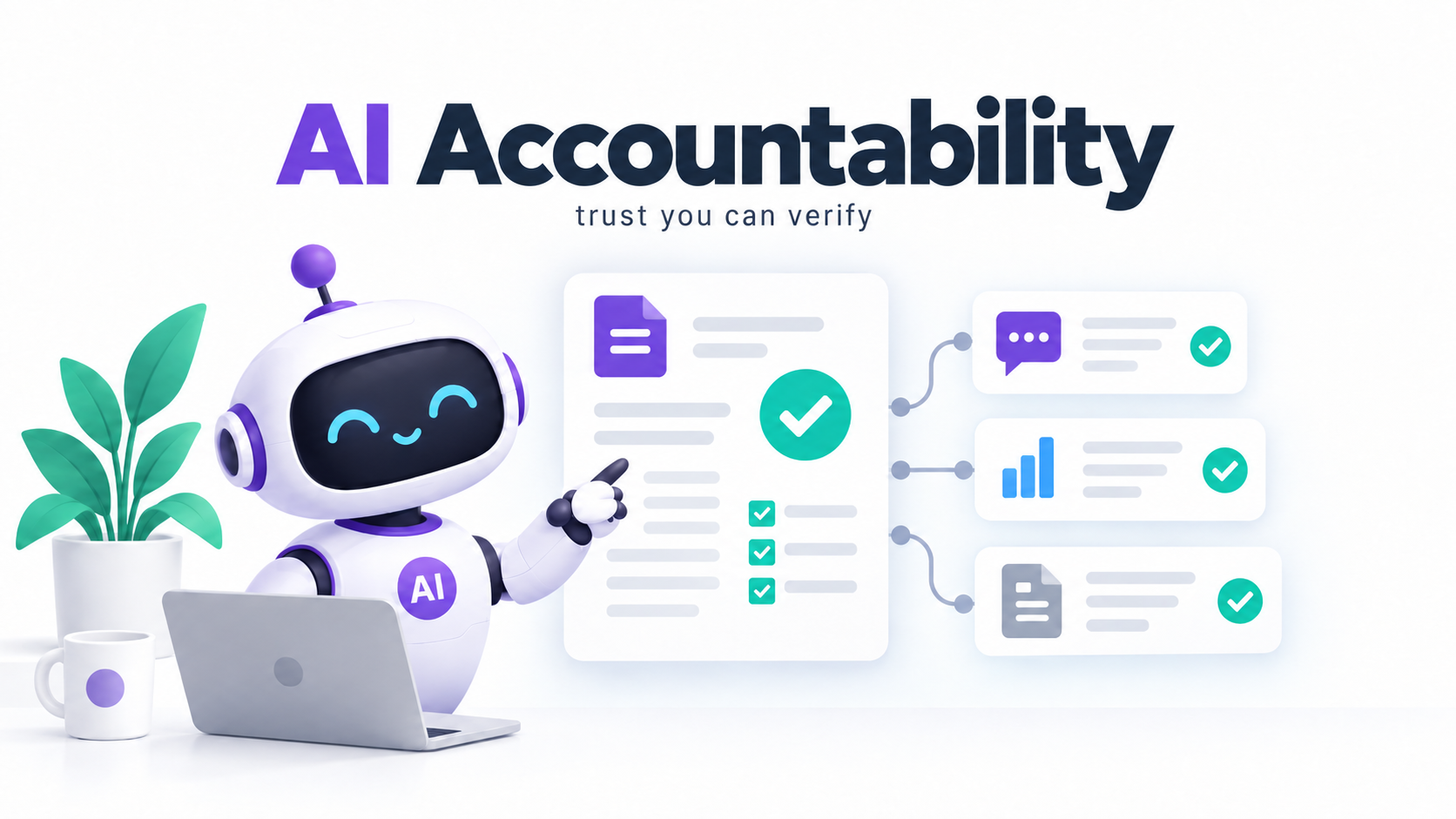
One of our core beliefs at lyfe.ninja is that trust should be verifiable.
It's easy to talk about content verification. It's harder to build it into the systems you use every day.
Over the past several months, we've been developing the infrastructure behind our upcoming content signing and verification platform. That includes a production signature service, a Python SDK, browser-side JavaScript and CSS helpers, and the supporting systems needed to sign and independently verify content.
Recently, we took an important step. We integrated that same infrastructure directly into our own AI assistant.
Every assistant response is now signed before it is delivered to the user. Verification occurs independently using the same services and libraries that external developers will eventually have access to.
This integration has been invaluable. It allows us to test the platform under real-world conditions, validate our developer experience, and identify improvements before broader availability.
More importantly, it helps ensure we are holding ourselves to the same standard we expect from others. If we believe AI-generated content should be verifiable, then our own AI systems should be verifiable too.
The integration currently uses:
While still early, this milestone represents an important step toward making content verification easier to integrate into real-world applications. We still have work to do, but the foundation is coming together.
Check it out by clicking the chat icon in the top right. Try tampering with the AI-generated content using your browser dev tools and see what happens.
Stay tuned…
Consider this our take on the “Know Your Agent (KYA)” dilemma. Turns out, signatures created with our BlkBolt™ tech are uniquely enabled to solve this problem.
AI agents are evolving fast. New models. New versions. New behaviors. Benchmarks change, systems get updated, and suddenly the thing you deployed last month isn’t quite the same anymore.
The general mantra seems to be…“Looks right…probably fine.”
With backgrounds in risk management and cyber security, let's just say, that feels… optimistic.
We’ve been thinking about a slightly different approach:
The core concept is simple:
In a world of rapidly changing AI models and agents:
The goal is to make it very simple.
At a high level:
In addition to our key differentiator of revocability, BlkBolt™ produced signatures offer several additional benefits such as:
It’s early and a bit scrappy, but the core idea works. We think this becomes more relevant as agents act on behalf of users, systems get more autonomous, multi-agent systems become the norm, and trust shifts from “the app” to “the output”. We’re curious what you think!
Digital signatures are everywhere. From software updates to financial transactions, they form the backbone of how we verify authenticity and integrity in modern systems.
For decades, that foundation has been built on cryptographic schemes like RSA and ECDSA, approaches grounded in well-established mathematical principles and public/private key infrastructure.
At lyfe.ninja, we’ve been exploring a different direction. While we are actively pursuing research opportunities to better evaluate the encoding strength of BlkBolt™, we’ve increasingly been drawn to digital signatures as a practical and immediate use case. This led us to a simple question:
BlkBolt™ takes a different approach. Instead of keys, it uses trained models to encode and verify data. The result is a signature artifact tied not to a key, but to a model-based representation of the input.
At a high level, both approaches achieve the same core goals:
Traditional digital signatures are permanent by design.
Once something is signed:BlkBolt™ introduces a different model. Signature validity can be actively controlled after issuance.
Because verification depends on the model:In the real world, trust is rarely permanent.
To be clear, this isn’t about replacing RSA or ECDSA. Traditional digital signatures are proven, standardized, widely trusted, and interoperable.
BlkBolt™ is simply exploring a different approach for situations traditional signatures are not well suited for. This approach becomes interesting in scenarios like:
Traditional signatures answer: “Was this signed?"
BlkBolt™ signatures open the door to: “Is this still valid?”
We’re still early in evaluating BlkBolt’s properties, especially from a formal security perspective.
That’s why we’re actively looking for:If you fit in one of these categories we'd love to hear from you. Please reach out via our Contact page or by filling out our Work With Us form.
👉 Try the Revocable Signature Demolyfe.ninja is pleased to announce that it has joined the CyLab Venture Network at Carnegie Mellon University!
Over the past 18 months, lyfe.ninja has been developing BlkBolt™, a research-driven data protection system exploring neural-network-based approaches to data encoding with a focus on isolation, and long-term resilience. The Venture Network provides an opportunity to engage with a broader community of cybersecurity researchers, founders, and practitioners while continuing to refine real-world applications of this technology.
Participation in the CyLab Venture Network reflects lyfe.ninja’s commitment to thoughtful technical dialogue, external validation, and collaboration at the intersection of deep learning and next-generation data protection.
We look forward to engaging with the CyLab community over the coming year.
We’ve launched a new interactive demo showcasing one experimental use case of our core technology, BlkBolt™: a revocable, model-verified signature for digital files.
The demo lets you:
Today, we’re excited to publicly share a major milestone for lyfe.ninja: the submission of a provisional patent titled “System and Method for Neural Network-Based Data Encoding Using Randomized Tokenization and Latent-Space Representation.”
This filing represents the foundation of BlkBolt™, a new data protection technology born out of our long-running research initiative, Project BlackBox.
For years, cryptocurrencies like Bitcoin and Ethereum have been celebrated as secure, decentralized systems that can’t be hacked or forged. Their security relies on strong cryptographic algorithms—mathematical puzzles that are practically impossible for today’s computers to solve.
For example, cryptocurrency wallets are protected today by elliptic curve cryptography (ECC), which powers the digital signatures that prove you own your coins. The math behind ECC makes it virtually impossible for current computers to guess your private key from your public wallet address—that’s why wallets are considered secure.
But quantum computers change the game. Using Shor’s algorithm, a sufficiently powerful quantum computer could one day crack those elliptic curve signatures—revealing private keys from public addresses. In simple terms, that means a hacker could steal funds directly from exposed wallets.
This isn’t possible with today’s quantum machines—they’re still too small and error-prone. But most researchers believe it’s simply a matter of time for these threats to come to fruition. And since blockchain data is permanent, attackers could already be storing information today to exploit later.
The good news: researchers worldwide—including us at lyfe.ninja—are developing new cryptography technology fit for a post-quantum world to protect your wallet before that day comes. One initiative, project BlackBox, explores novel approaches to encryption and digital signatures. One especially exciting idea? Your own customized digital signature algorithm—a security layer unique to you.
Bottom line: Your wallet is safe today, but without quantum-resistant upgrades, it may not be tomorrow.
Keep an eye out 👀 for some exciting updates coming soon!
We just gave our website a serious intelligence upgrade. Meet the newest member of the lyfe.ninja team: our very own AI-powered chatbot — live now and ready to answer your questions 24/7.
Want to know what BlackBox Encryption is? Curious about Project NeuroID? Wondering what exactly we do at lyfe.ninja besides building cool sci-fi-sounding tech?
Just click the little 💬 chat bubble in the top right corner and ask away.
This isn't your average chatbot. It's been trained on our actual business documents, project charters, and service offerings — no hallucinations, no filler. Just straight, fact-based answers about:
Ever wonder what happens when you set your own house on fire—just to see if it burns?
That’s kind of what we’re doing here.
We’ve launched a public brute-force challenge against a model from our BlackBox Encryption project. Every few minutes, a scheduled process spins up in the cloud and takes a wild shot at cracking 100 encrypted secrets using nothing but random noise and bad intentions.
So far? Hundreds of billions of attempts. Zero hits.
The closest guess is still several edits away from the real thing (thanks, Levenshtein distance).
But here’s the kicker:
If Brute Force Attempts, Closest Distance, or Days Without Hit ever hit zero, that’s game over.
Mission failed. Keys to the kingdom = revoked. 🔐
Until then, it’s live, it’s public, and it’s kind of hilarious.
👉 Come watch the madness.
Check out our new Work With Us page! A place for organizations, startups, and innovators to connect directly with lyfe.ninja.
Whether you're looking for expert data science and machine learning consulting, or seeking a strategic partner for your next breakthrough project, we’re here to collaborate. From prototyping and model deployment to secure system design and AI integration, we bring real-world experience across industries to help you move faster and smarter.
Visit the page to learn more and start a conversation with us.
We're excited to announce Project NeuroID, our newest innovation in user-first authentication. NeuroID replaces static credentials and device-based factors with what you remember: unique, natural-language phrases that only you know. A custom neural model is trained per user, verifying input through inference — no passwords, tokens, or stored identifiers required. This system is:
Q-Day is coming. The moment when quantum computers reach the capability to break today’s most widely used encryption methods isn’t just theoretical — it’s inevitable. And when that day arrives, the digital infrastructure we rely on to protect everything from personal communications to national secrets could be rendered obsolete overnight.
At lyfe.ninja, we’re not waiting for that day. We’re building for what comes after.
Project BlackBox is our answer to the looming post-quantum security crisis. Unlike conventional encryption systems like AES or RSA — which rely on fixed mathematical rules — the encoding system in development uses deep learning to dynamically encode and decode data. This model-driven approach produces high-dimensional, non-deterministic representations. Each model is uniquely trained for its specific use case, helping to mitigate common attack strategies, such as precomputed hash attacks, while aiming to make standard attack methods infeasible.
The quantum threat is coming fast. Project BlackBox is how we’re preparing — and how we plan to help others do the same as the technology matures.
We're excited to announce that lyfe.ninja LLC is now part of the Google for Startups Cloud Program. In addition to Google Cloud credits, we also get access to developer-friendly technology, resources, and support that help us build easily.
Stay tuned for more updates coming soon!
We’re excited to announce the birth of lyfe.ninja LLC, a company dedicated to building and providing cutting-edge data science and machine learning products and services. Our mission is simple: to harness the power of data with data science and AI/ML to create intelligent solutions that drive real impact.
While we’re operating in stealth mode for now, big things are on the horizon. Stay tuned as we push the boundaries of what’s possible in AI/ML, data, and innovation.